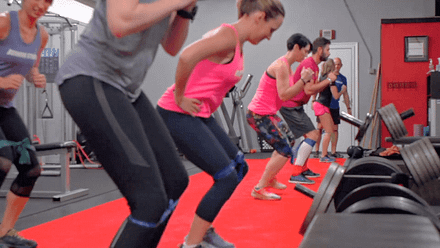

What is a Running Gait Analysis? A Real-Life Example
Many runners are curious about what a running gait analysis involves and how it might help their running performance. With permission from my friend, Danielle, we’re going to provide a detailed view of her gait analysis, from start to finish, to give you an idea of how a running analysis may help you.
Gait Analysis in a Nutshell
Running gait analysis assesses an individual's training history and running form to identify any irregularities, imbalances, or inefficiencies in their running style. We use these findings to create a personalized plan to improve their running form.
My process is heavily influenced by my training with Jay Dicharry, PT, at the UVA SPEED Clinic running gait lab, my experience performing hundreds of analyses, and countless lectures, articles, books, & podcasts over the last 13 years.
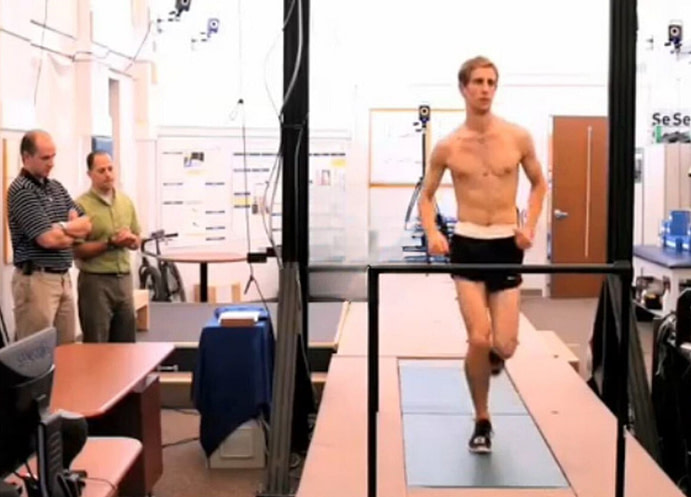
We won't cover every single detail, but hopefully you'll get a good sense of how in-depth our PR Running Gait Analysis goes. After collecting background info before meeting, we then spend 2 hours together during the gait analysis. Processing the data & creating your gait report and improvement plan usually takes a few more hours.
What our Gait Analysis Isn't
Most runners are exposed to “gait analysis” when they shop for running shoes at a store and are asked to walk barefoot or in different shoes while the salesman watches their gait. Unfortunately, this type of gait analysis is based on outdated practices of observing arch height and pronation, things that recent research has shown aren’t relevant to running injuries. Then they recommend a type of shoe such as neutral, stability, or god forbid, motion control, which also doesn't help with injury prevention. I've also seen 3D foot scanners in some stores to help match you with a better-fitting shoe, but I haven't seen evidence that this works any better than trying on a shoe and choosing what feels best. Overall, these 'free gait analyses' are likely worth what you pay for them.
On the other end of the spectrum, there is a prestigious university offering a 1-hour, $400 gait analysis that is broken up into 15-minute stations for history, gait analysis, biomechanical screening, and nutrition. From my perspective, 15 minutes is barely enough time to collect good data for any one of those topics, and certainly not enough time to teach anything besides cookie-cutter recommendations.
The PR MD Approach
Our goal is to offer a valuable, individualized gait analysis at a reasonable price in order to help you meet your goals.
Danielle's Real-Life Running Analysis
We start with your running goals in mind and work backwards in order to figure out the steps necessary to reach those goals. Danielle's biggest goal was to improve her running form & efficiency. Although she was healthy and running pain-free at the time, she had a significant history of running injuries including "metatarsal stress fracture, hamstring strain, peroneal tendonitis x3, and metatarsal stress reaction." Because consistent training is the single best way to get better at running, I wanted to also look closely for risk factors that we could modify to help with injury prevention.
At the time of our gait analysis in 2021, Danielle was in her 20s, studying to be a physical therapist, working as a trainer, and using a running coach. She'd been running for about 6 years and had raced distances from 5K to the marathon, plus some triathlons. She ran about 30 miles per week, with the "majority easy runs sometimes with strides, 1 workout/speed/threshold session per week, 1 long run per week that sometimes has threshold work built in it depending on race goals."
Running Mechanics - Measured
After reviewing her history, we calibrated our RunScribe sensors on each shoe & her low back, allowing us to get precise measurements of running form variables like foot strike, stride length, vertical oscillation, and ground contact time. RunScribe also provides acceleration and shock data, correlating closely to kinetic data that previously could only be measured by force plates in a biomechanics lab. Next, she warmed up on the treadmill for a few minutes in order to get into her natural stride (treadmill running has been shown to be very similar to running outdoors).
Assessing Her Running Form
Watch Danielle's slow-motion videos and see what you notice in her running gait:
Biomechanics Screening
We'll come back to her running videos, but next we did a few more tests to evaluate her biomechanics and movement patterns. Just watching someone's running form tells you what they do, but this needs to be combined with a thorough physical exam to know why they do it.
We started with a few Hop Down tests:
With this test we assess jumping and landing mechanics looking at her foot, knee, and hip position as well as overall power output.
Then we looked at Single Leg Squats or Step Downs:
With these we assess foot control, balance, hip strength, and trunk control.
Running-Specific Range of Motion
Next we evaluated her range of motion:
Hip Extension: both sides showed 10 - 20 degrees
Knee Flexion: both sides showed adequate range
Hip Flexion: both sides showed > 70 degrees
Ankle Dorsiflexion: both were > 30 degrees
Great Toe Extension: both were > 30 degrees
Her foot anatomy showed a neutral rear foot position but some mild forefoot varus leading to a loss of first ray ground contact in a sub-talar neutral position. Note this is not Danielle's foot but is a similar example of her findings.
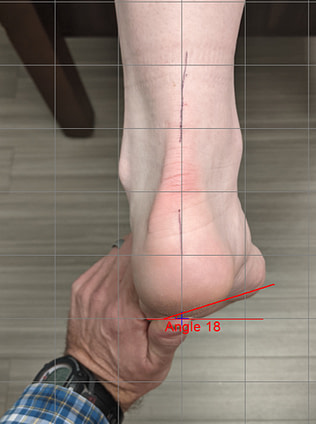
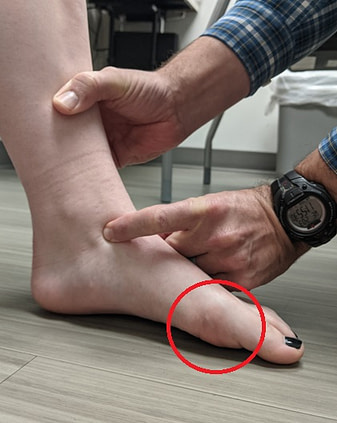
This is a risk factor for abnormal foot biomechanics and possibly related to her prior 4th metatarsal stress fractures and peroneal tendonitis. The big toe accounts for ~ 85% of our stability, but it can't do its job well if it has trouble contacting the ground.
Putting it Altogether
After testing, we reviewed the data we collected, focusing on the most relevant findings as we started formulating our treatment plan. For the sake of brevity, I'll group together the main issues we found with the parts of the plan to improve each issue.
Improving Her Feet
We discussed how her varus forefoot can cause issues, such as hyper-pronating in order to get her big toe on the ground. Her peroneus longus may have become inflamed from overworking trying to pull her first ray down. RunScribe also showed that her foot center of pressure moved outward toward the small toes rather than tracking over the big toe as we should see.
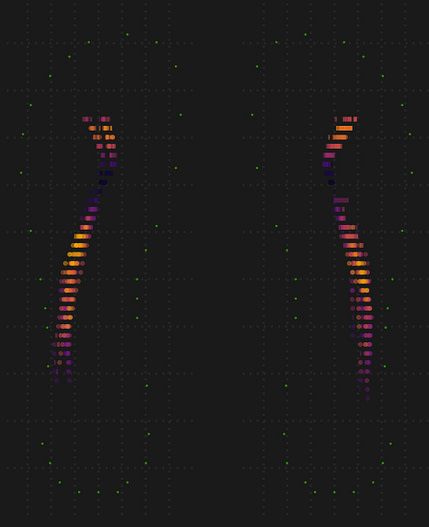
We practiced a mobility drill to help loosen up that lateral band of her plantar fascia in order to get the big toe down more easily.
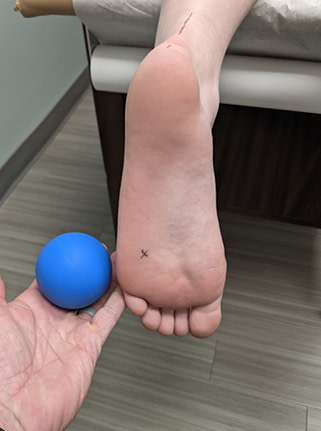
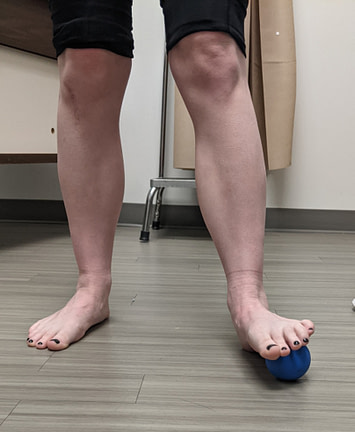
Although a lacrosse ball can get the job done, now that the Wedge from MOBO Board is available I would recommend it instead.
Since she owns a MOBO board, I also recommended incorporating one of these exercises a few times a week to improve her foot control after loosening it up.
Decreasing Over-Striding
Although minor, Danielle was over-striding. We would like to see her foot strike occuring a little closer to her body and with a more vertical shin angle.
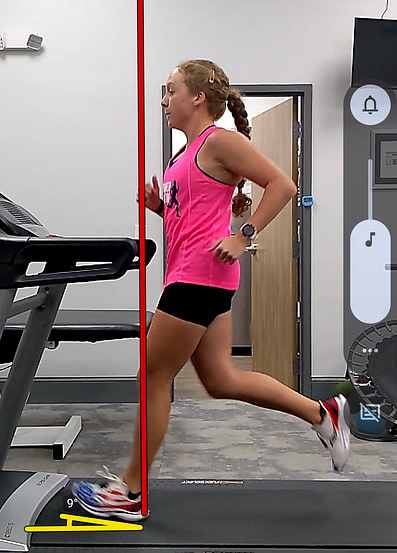
Her RunScribe data also showed that her braking forces at initial contact were higher than impact forces, especially with faster running. This is another indicator of over-striding and a risk factor for injuries.
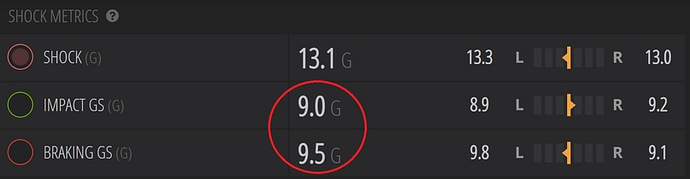
Since her cadence was already high (184 steps per minute), we didn't think increasing it was the best way to improve this, so instead we discussed shifting her stride posteriorly, pushing off farther behind her & then landing closer, especially when running faster. She was noted to be using less hip extension than she had available, so we focused mostly on dynamic hip extension exercises that she could add to her workouts.
She could incorporate exercises like:
Posture
The last big issue we discussed was posture. She has mild thoracic kyphosis (hunched forward) and rounded shoulders. While this is partly just her anatomy, some of it was probably postural due to muscle tightness from biking and swimming and could be improved. Often this hunched upper back posture leads to over-arching the low back, compromising core stability. Danielle showed slight low back arching when toeing off while running, so we decided it was worth working on her upper back.
We gave her a progression of different mobilizations she could include in her warm-ups:
Plus upper back & scapula strengthening exercises:
Plus some waiter & overhead plate carries to reinforce tall, stacked posture under load:
When I sent her report detailing the things discussed above, I also brought up a few other points based on our discussions that day. We discussed a few sports psychology tips to help her reframe how she thought about her training and to give herself some grace. She agreed it was something she should work on. We also reviewed nutritional suggestions to optimize bone health such as supplementing vitamin D and getting enough daily protein.
I reminded her that I would be available to answer any questions about her gait analysis and treatment plan.
I'd love to tell you that she followed the plan to the letter and ran happily ever after, but things don't always work that way in the real world. She did have one of her best training blocks after our analysis, but eventually injuries cropped up again. Like every runner, and especially as a new PT, Danielle continues to learn and improve through education and experience. I have no doubts that she'll continue to improve as a great athlete, therapist, and coach!
If you have any questions about this particular analysis or gait analysis in general, please comment below! If you'd like to schedule your running analysis, please fill out the contact form at the bottom of the page and I'll be in touch soon!
Happy Running!
Kasey Hill, MD,
Running Coach, Gait analyzer
Disclaimer
This website provides information only, and does not provide any financial, legal, medical or psychological services or advice. None of the content on this website prevents, cures or treats any mental or medical condition. You are responsible for your own physical, mental and emotional well-being, decisions, choices, actions and results. PR MD Running disclaims any liability for your reliance on any opinions or advice contained in this website. Kasey Hill MD is a medical doctor & running coach, but he is not your doctor or coach unless you become his patient or client by booking a medical or coaching consult, and he is not offering medical advice on this website. If you are in need of professional advice or medical care, you must seek out the services of your own doctor or health care professional.